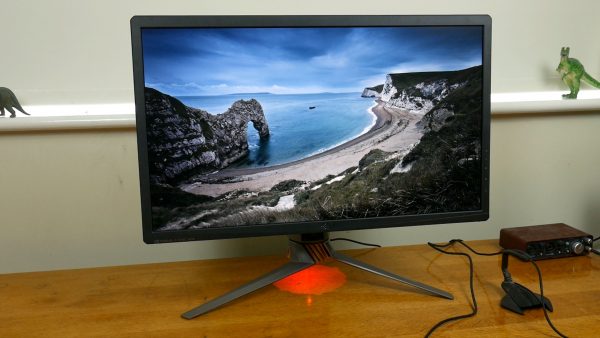
Editors Liked
- G-Sync HDR technology
- Peak brightness of 1,000 nits
- Fast refresh rate (144Hz overclocked, 120Hz native)
- Great image quality
- Superb gaming performance
Editors Didn’t Like
- Very expensive
- Still only a 27-inch display
- You need a top-tier graphics card to power this panel fully
The pros are fairly obvious, in that everything looks amazingly sharp, from video and images, to games and even the thumbnails you’ll see on sites like YouTube. Fire up a high quality 4K video, in particular, and the incredible amount of detail brings an almost 3D like depth to the image.
However, the downsides are that with this being only a 27inch display you’ll have to use Windows scaling to make things a readable size, which in turn means you don’t get a larger desktop area than any other 27inch monitor. Plus, Windows can still sometimes mess up the scaling and, when gaming, if you’re not able to get good enough performance at 4K and have to drop the resolution, it looks worse than running a game at the native resolution of a lower resolution screen.
As such, it really depends what your priorities are and how you tend to use your PC, as to whether the 4K will be of benefit here.
To a certain extent the same can be said of HDR, as of course, it only works with HDR content, which isn’t exactly commonplace. Video support is reasonable, though not always easy to access from a PC, but there are still very few games that support it, with no great commitment from publishers to ramp up that support.
Nonetheless, when you do get to experience it, the results are amazing. The huge leap in contrast adds so much dynamism to video and games. Explosions leap from the screen while the inky blackness of night or the darker depths of a dungeon aren’t spoiled by the greyness of a normal LCD backlight.
Meanwhile, the extended colour range of HDR, while often slightly more subtle, can really shine in certain instances too. Watching the dazzling green of foliage on a bright sunny day and it makes you realise what conventional video has been lacking all this time.
What’s more, you still get much of the benefits of HDR in normal non-HDR content just by having the variable backlight on. Black bars above and below video are actually black rather than grey and just generally you get more of that depth.
However, the one thing to note is that this display can’t really do justice things like stars or fireworks against a night sky. Even with 384 of them the backlight zones are still too large to have the granularity required to pick out all those tiny points of light.
Overall, then, the PG27UQ is an interesting beast. On one level, it absolutely lives up to the hype in terms of being the single best 27inch gaming monitor you can buy. The combination of 4K and HDR looks amazing while core image quality is fantastic and gaming performance is right up there as well.
It’s just that for such a high price it feels like a bit of a jack of all trades and master of none.
Sure, it’s the master of HDR for any gaming monitor right now but, for instance, if you’re after the ultimate competitive gaming monitor, far cheaper, lower resolution monitors technically out perform it. Meanwhile 4K feels somewhat superfluous on such a relatively small display. Indeed larger, and particularly ultrawide displays seem like a much more natural fit for watching HDR video and providing that really immersive HDR gaming experience. Plus most larger displays get you a bigger desktop area.
As such, it strikes me that a far more compelling debut for such high-end HDR should have been with an upgrade to the 34in ultrawide, PG348Q. Just add HDR, without even upping the resolution or refresh rate and you’ve got a really compelling proposition.
So, if you’ve got the money, the PG27UQ certainly won’t disappoint, but somehow it doesn’t quite feel like the aspirational upgrade that the likes of the PG279Q or PG348Q were before.
 Computer Tech Trends